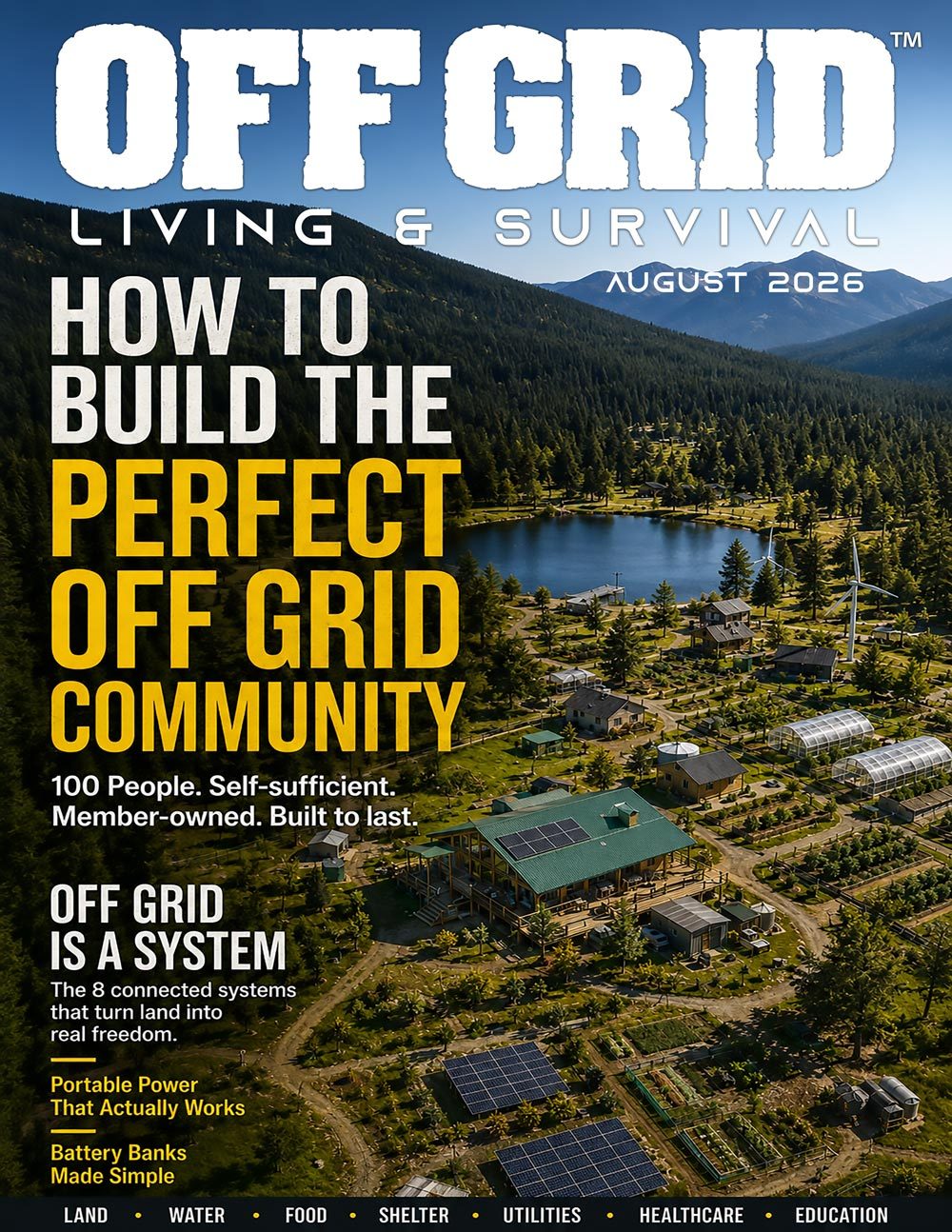
Here's how to build your off grid dream and save a million dollars over 30 years!
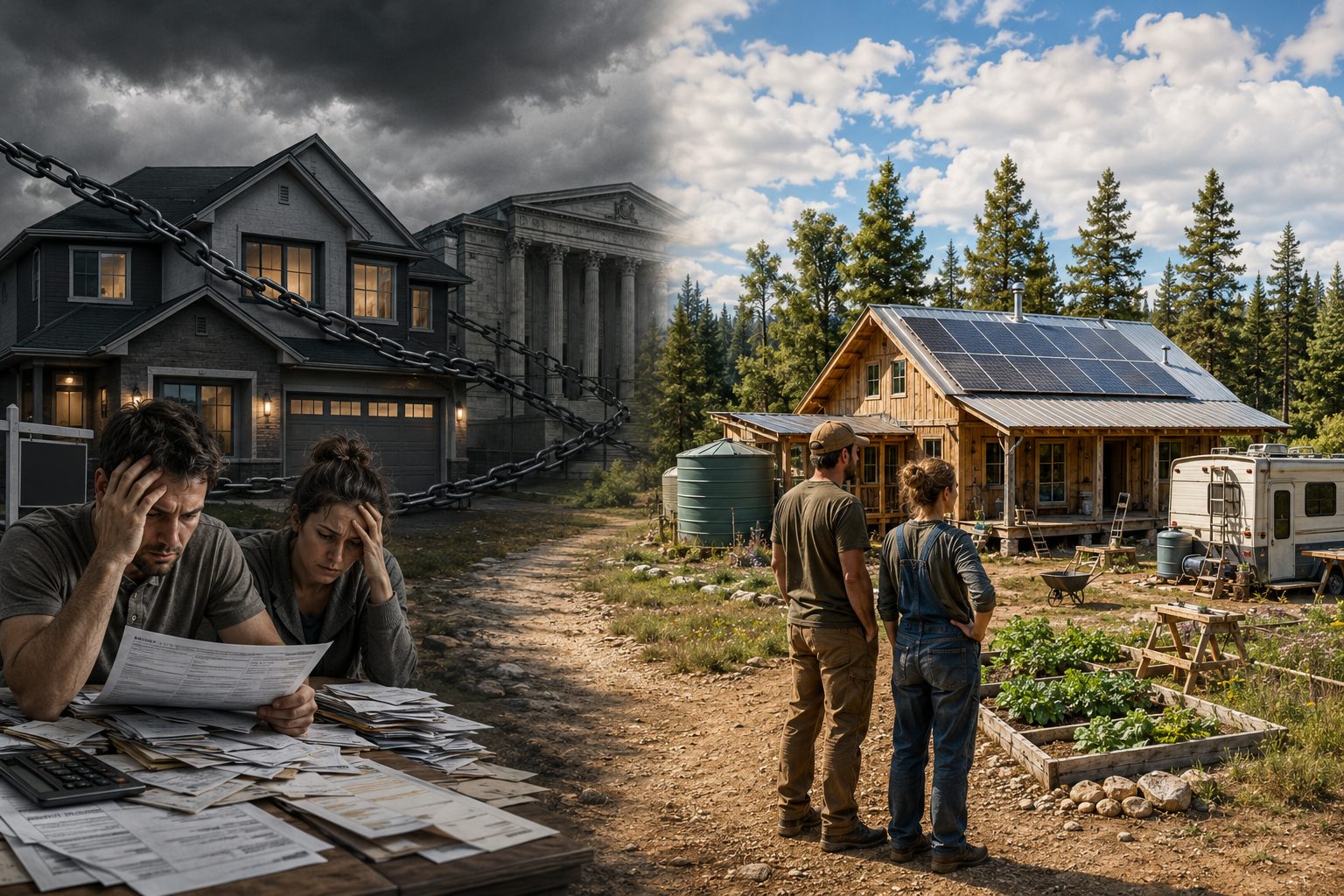
Got an off grid dream? You are not going to save your way there on minimum wage. The odds and the system are stacked against you.
Here is what the numbers actually say in July 2026.
The median existing home in the US sold for $440,600 in June. The 30-year fixed is averaging 6.58%. Put 20% down and you are looking at roughly $2,250 a month in principal and interest, before taxes and insurance. Call it $2,900 to $3,100 all in.
To keep that at 30% of your income you need about $115,000 a year. That is roughly $55 an hour, full time.
Here is the thing though. In the real world, most people never use that 30% number. They are spending closer to 50 or 60% of their income just on rent or the mortgage, and everything else has to squeeze into what is left. They know they need 1,200 or 1,500 or 2,000 dollars a month for the roof over their head, so that is what they aim to make, plus enough on top for utilities, insurance, food, gas, the phone bill, tuition, all of it. That is the actual math most households are running, and it is why so many people have quietly accepted they will never own a home. It is not a saving problem. It is priced out of reach.
The 30% rule is what you are supposed to be able to afford. What people actually live on is a whole different picture.
The federal minimum wage is still $7.25. It has not moved since 2009. At $7.25 you would need about 1,300 hours a month to cover that payment. There are only 730 hours in a month.
This is not a matter of working two or three jobs. It cannot be done on minimum wage at all. MInimum wage is supposed to be increased based on cost of living to be effective. It effectively needs to match inflation, otherwise it continues to have less and less buying power every year.
Now, a lot of states got tired of waiting on D.C. to raise the federal minimum wage, and raised their own floors, some to more than double the federal rate. And here is the gut punch: even at double, it still is not enough. Here are the ten highest minimum wages in the country in 2026.
- District of Columbia: $18.40
- Washington: $17.13
- Connecticut: $16.94
- California: $16.90
- Hawaii: $16.00
- New York: $16.00
- Rhode Island: $16.00
- New Jersey: $15.49
- Colorado: $15.16
- Arizona: $15.15
Even the top of that list, over 18 dollars an hour, is a third of the roughly 55 dollars an hour you need to carry a median mortgage, and it still falls short of the 34 dollar and 73 cent housing wage just to rent a modest two bedroom.
Renting is not much better.
The National Low Income Housing Coalition's Out of Reach 2026 report, released this week, puts the national housing wage at $34.73 an hour for a modest two bedroom and $29.19 for a one bedroom. On Florida's current $14, that is about 99 hours a week for a two bedroom, 83 for a one bedroom. Florida hits $15 on September 30 and it still does not close the gap.
About half of adults in America own their home. The other half do not. And that second half is not all renters. Around 14% of adults live in a home someone else in their family owns, because they cannot afford a place of their own. That is young adults still living with their parents, and it is elderly parents moving back in with their grown children. People who are not renting and not owning. They are just stuck under someone else's roof because the math of a place of their own does not work.
Off grid changes that math, but only if you change the whole plan. Raw rural land is still cheap in much of the country. USDA put average farm real estate at $4,350 an acre in 2025, ranging from $725 an acre in New Mexico to $22,500 in Rhode Island. Land, an owner-built structure, and your own power, water and septic is a completely different animal than a $440,000 mortgage. That path is realistic somewhere around $25 an hour. A conventional house is not.
My position: minimum wage should easily cover your housing, food and utilities, plus healthcare and education and still leave you with money for your kids' college and maybe a vacation each year with the family. I don't think that's unreasonable. What is unreasonable is expecting people to live on less than it takes to afford a 2 bedroom home.
This is why millions of people are looking to move off grid to cut costs and save money. But land prices are going up and soon, even buying land could be too expensive for most people to afford.
Money! That's what you need to buy land and build your home. And if you're not well employed, own a successful business you may not ever achieve your dream to move off grid.
Now let's talk about going off grid and saving 80-90% of your cost to buy and build your own home.
What it actually costs to put a roof over your head
There are two ways to get a home. Here is what each one really costs.
Path one. Buy the median American home.
The median existing home in America sells for $440,600. Put the standard 20% down and that is $88,120 in cash you need up front, before you ever get the keys. You borrow the remaining $352,480. At today's average 30 year fixed rate of 6.58%, your principal and interest runs about $2,246 a month. Add the national average property tax and homeowners insurance and your real payment is about $2,829 a month.
To keep that at 30% of your income, the standard measure of what you can afford without going broke, you need about $113,000 a year. That is roughly $54 an hour, full time.
And here is the part nobody puts in the listing. Over 30 years you will pay about $456,000 in interest alone. That is more than the house cost. Counting your down payment, that $440,600 house costs you about $897,000 by the time it is yours.
Path two. Build the same house yourself, on your own land.
Same size home. The national median is 2,194 square feet, so that is what we are comparing. Built conventionally by a builder, that house costs about $329,000 in labor and materials.
Here is how that $329,000 splits. Labor is a little over half. Materials are the rest. Those are the only two things you are paying for.
Now cut both.
Buy land that already has what you need on it. Timber for your lumber. Rock for your chimney, your walls. Clay, sand, and gravel. If the material is standing on your own dirt, you are not buying it from a lumberyard. That takes your material cost down by 80 to 90%.
Then do the work yourself. That takes your labor cost down by 80 to 90% too.
Not 100% on either one. You will still buy fasteners, roofing, windows, wire, and pipe. You will still hire out the work you cannot legally or safely do. But cutting both sides by 85% takes that $329,000 build down to about $27,000 in labor and $22,000 in materials.
Add about $22,000 for five acres of usable land.
The specialty work you will have to hire out:
-
Well drilling: about $12,000
-
Septic system: about $10,000
-
Electrical, whether off grid solar or a grid tie: about $8,000
-
Heating and cooling: about $6,000
-
Foundation, permits, and inspections: about $6,000
That is about $42,000 for everything a licensed contractor has to touch. Every house needs these. There is no way around them, and you should not try.
Total out of pocket for the DIY build: about $113,000. And no mortgage attached to any of it.
The comparison, plain.
Buying that median home costs you close to $900,000 over 30 years, and you need $54 an hour just to qualify for the loan.
Building the same square footage yourself, on land that supplies your own materials, lands near $113,000 total. That is about a quarter of the sticker price of the bought house, and about 13% of what that house actually costs you once the bank is done with you.
Same size roof over your head. One of them owns you for 30 years. The other one you own, free and clear, and you can build it in stages as the cash allows.
You can stay in a travel trailer or tiny house, or camper while you build.
PATH ONE: BUY THE MEDIAN HOME
Purchase price: $440,600
Down payment, 20%: $88,120
Amount borrowed: $352,480
Interest rate: 6.58%, 30 year fixed
Monthly breakdown:
Principal and interest: $2,246
Property tax: $375
Homeowners insurance: $208
Monthly total: $2,829
Yearly: $2,829 x 12 = $33,948
30 year math:
$2,829 x 360 payments = $1,018,440
Plus down payment: $1,018,440 + $88,120 = $1,106,560
Of that, interest alone:
$2,246 x 360 = $808,560
$808,560 minus the $352,480 borrowed = $456,080 in interest
PATH ONE TOTAL: $1,106,560 over 30 years. You own it on the last day.
PATH TWO: BUILD IT YOURSELF ON YOUR OWN LAND
Same size home, 2,194 square feet. Conventional builder cost: $329,100.
Labor is a little over half. Materials are the rest.
Cut both by 85% by harvesting your own materials and doing your own work.
DIY labor: $27,000
DIY materials: $22,000
Land, 5 acres: $22,000
Well drilling: $12,000
Septic system: $10,000
Electrical: $8,000
Heating and cooling: $6,000
Foundation, permits, inspections: $6,000
The math:
$27,000 + $22,000 = $49,000
$49,000 + $22,000 land = $71,000
$12,000 + $10,000 + $8,000 + $6,000 + $6,000 = $42,000 specialty work
$71,000 + $42,000 = $113,000
PATH TWO TOTAL: $113,000. Paid up front. Owned free and clear from day one.
PROPERTY TAX (separate line, you pay this either way)
DIY home: about $1,530 a year, about $128 a month.
Over 30 years: $1,530 x 30 = $45,900
Bought home: already included in the $2,829 monthly above, at $375 a month, $4,500 a year, $135,000 over 30 years.
THE COMPARISON
Buy: $1,106,560 over 30 years
Build: $113,000 one time
$1,106,560 minus $113,000 = $993,560 saved
Monthly: $2,829 to buy. $128 in tax to own what you built.
Yearly: $33,948 to buy. $1,530 in tax to own what you built.
The bought house costs you nearly ten times what the built house costs. You pay $456,080 in interest to a bank for the privilege. Build it yourself and that money stays in your pocket, and you own the place outright the day you drive the last nail
You can still get there
Stop playing a game that's rigged. Make your own rules. Buy you own land. Build your own home. You are not failing. The system failed you. $54 an hour and a bank that takes $456,080 in interest is not a dream, it is a tether chaining you with mortgage debt for the next 30 years.
Take back your freedom by owning your own land, building your own home and owning your own infractructure to be 100% independent.
Buy the land. Cut your own timber. Pull your own rock out of the ground. Live in the camper while you frame the walls. Hire the well driller and the electrician, because those are the ones worth paying for, and build the rest yourself. If you need help with the big stuf, hire it out on a temp basis. There's no rush. You have 30 years to build it. It will take longer than a closing date. You will be tired. You will learn things you never thought you would know.
And then one day you walk out to the porch of a house that nobody holds paper on. No landlord. No lender. No payment due on the first.
Just your land, your roof, your water, your power, and thirty years of your own money still in your pocket instead of somebody else's.
That is not a fantasy. That is $113,000 and a plan.
People are doing it right now, this year, with less than you think they had.
The dream is not gone. It just moved off the market and out to the land, and it is still out there waiting for whoever is willing to go get it.
The dream is possible. You just have to build it.
***
Sources
-
Median home price: National Association of Realtors, Existing-Home Sales, June 2026. https://www.nar.realtor/research-and-statistics/housing-statistics/existing-home-sales
-
Mortgage rate: Freddie Mac Primary Mortgage Market Survey, July 23, 2026. https://www.freddiemac.com/pmms
-
Housing wage: NLIHC, Out of Reach 2026. https://nlihc.org/oor
-
Florida minimum wage: Florida Department of Commerce. https://floridajobs.org/florida-minimum-wage
-
Federal minimum wage: US Department of Labor, FLSA. https://www.dol.gov/agencies/whd/flsa
-
Land values: USDA NASS, Land Values 2025 Summary. https://data.nass.usda.gov/Publications/Highlights/2025/2025LandValuesCashRents_FINAL.pdf
-
Home price: National Association of Realtors, existing home sales. https://www.nar.realtor/research-and-statistics/housing-statistics/existing-home-sales
Mortgage rate: Freddie Mac Primary Mortgage Market Survey. https://www.freddiemac.com/pmms
Housing wage: National Low Income Housing Coalition, Out of Reach 2026. https://nlihc.org/oor
Federal minimum wage: US Department of Labor, Fair Labor Standards Act. https://www.dol.gov/agencies/whd/flsa
Florida minimum wage: Florida Department of Economic Opportunity. https://floridajobs.org/florida-minimum-wage
Land values: US Department of Agriculture, 2025 Land Values Summary. https://data.nass.usda.gov/Publications/Highlights/2025/2025LandValuesCashRents_FINAL.pdf
Renter cost burden: Harvard Joint Center for Housing Studies, America's Rental Housing 2026. https://www.jchs.harvard.edu/americas-rental-housing-2026
And their State of the Nation's Housing 2026. https://www.jchs.harvard.edu/state-nations-housing-2026
Homeownership rate: US Census Bureau, Housing Vacancies and Homeownership. https://www.census.gov/housing/hvs/current/index.html
Real ownership by person: Federal Reserve Bank of Minneapolis. https://www.minneapolisfed.org/article/2026/new-homeownership-measure-puts-people-first
***
If you got something out of this article and it was useful to you, the best way to support this blog and the community is to subscribe to my off grid magazine. Every subscriber keeps the research, the numbers, and the real world off grid guides coming.
Subscribe here get all the back issues for FREE! Included with your lifetime membership