
THE 100 MILE BUG-OUT BIKE: The best survival vehicle in the world
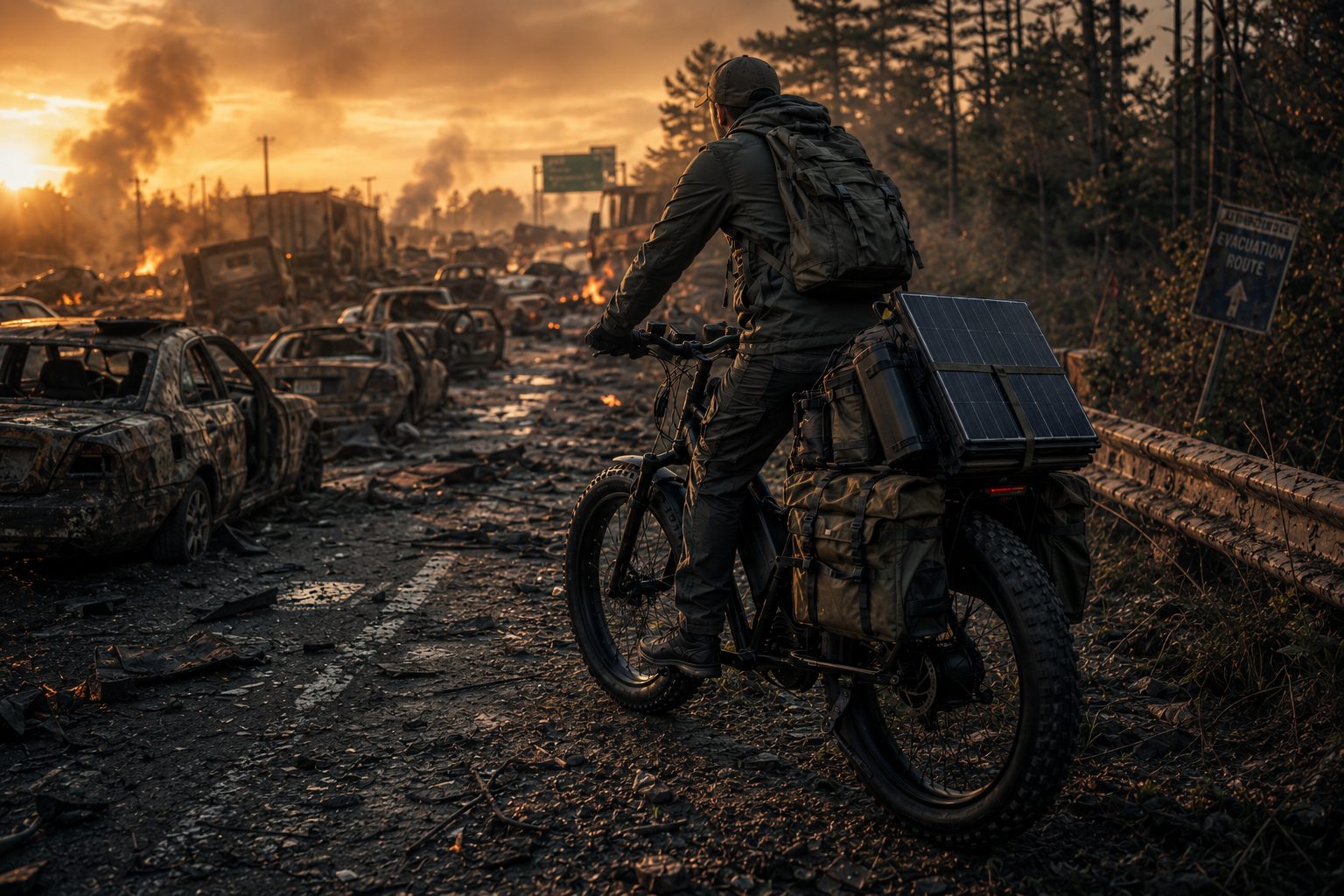
THE 100 MILE BUG-OUT BIKE
WHY AN EBIKE, THREE BATTERIES, AND A FOLDING SOLAR PANEL BEAT EVERY OTHER SURVIVAL VEHICLE ON EARTH
I've been saying this for years and I'm going to keep saying it until people stop looking at me sideways.
The single best bug-out vehicle you can own is not a lifted diesel truck. It's not a Bronco. It's not a side-by-side, an ATV, a dirt bike, or a converted school bus with solar on the roof. It's an electric bicycle with a rack, a set of saddlebags, three battery packs, and a packable solar panel strapped to the back.
That's it. That's the whole answer.
I get the same reaction I got 35 years ago when I told everyone I wanted a kayak to fish out of. Boat dealers laughed. My dad laughed. Everybody had a reason it wouldn't work. Now go look at any boat ramp in the country and count the kayaks. Count the fishing SUPs while you're at it. I was right then and I'm right now, and the guys telling me an ebike is a toy are the same guys who told me you can't fish out of a kayak.
So let's talk about why.
FAST, CHEAP, SILENT, AND AGILE
FAST. A modern Class 3 ebike will hold 28 mph on the flat. That's not a cruise, that's a working speed you can sustain for hours with pedal assist doing most of the labor. On foot with a loaded pack you're doing 2 to 3 mph and you're wrecked by mile eight. On an ebike you cover in one hour what a man on foot covers in a hard day. Think about what that means when the thing you're running from is also on foot.
CHEAP. You can be fully kitted out, bike and batteries and panel and bags, for less than the cost of a big screen TV. Compare that to a bug-out truck build. Compare it to what you'd spend on fuel storage, fuel stabilizer, rotation, and the fuel cost itself. An ebike costs pennies per charge right now and costs absolutely nothing once the panel is paid for.
SILENT. This is the one people underestimate the most. A hub motor at cruise makes less noise than the tires do. You will hear your own chain before you hear the motor. A truck announces you from a mile out. A dirt bike announces you from three. In a grid-down environment sound is a beacon, and every person who hears you gets to decide what to do about you before you even know they exist. An ebike lets you make that decision first. There's a reason special operations units have been quietly running electric bikes for years. They didn't buy them because they're cute.
AGILE. This is where the truck guys lose the argument completely and they don't even realize it yet.
THE ROADS WILL BE PARKING LOTS AND YOU KNOW IT
Everybody has seen the hurricane evacuation footage. I live in Florida. I've watched I-10 and I-75 turn into a 200 mile parking lot with people sleeping in their cars, out of gas, going nowhere. And that's an ORDERLY evacuation with working traffic control, working gas stations, and a National Guard presence.
Now take all of that away.
In a real collapse, every artery out of every city becomes a wall of dead vehicles. Wrecks. Burned hulks. Abandoned cars with the doors hanging open. Debris. Downed lines. Collapsed overpasses. And on top of the natural blockage you'll get intentional blockage, because the fastest way for a group to control a resource is to control the road that leads to it.
Your truck stops at the first wall. You back up, you find a detour, you burn fuel and daylight, you hit another wall, and eventually you are sitting in a metal box surrounded by strangers who can see exactly what you're carrying.
An ebike does not stop. You ride the shoulder. You ride the median. You ride between the cars. You ride the sidewalk, the drainage ditch, the bike path, the greenway, the railroad right of way, the powerline cut, the golf course, the field behind the shopping center. You go around the roadblock through the treeline a hundred yards off the road and the guys manning it never even know you passed.
Roadblocks and ambushes are built to stop vehicles. You are not a vehicle. You're a guy on a bicycle who can pick the whole thing up and carry it over an obstacle if he has to. Try that with a Tacoma.
YOU CANNOT GET STUCK. Read that again. Every other motorized option on earth can be immobilized. Mud, sand, a ditch, a ravine, a fallen pine across the trail, a washed out culvert. When a truck or a quad or a moto gets stuck you now have a two hour recovery problem, or you have an abandoned vehicle and everything you can carry on your back. When an ebike "gets stuck" you step off and walk it ten feet and get back on. Worst case on the planet, you shoulder it. A 60 pound bike is a bad carry but it is a POSSIBLE carry, and possible beats impossible every single time.
IT GOES ANYWHERE. LITERALLY ANYWHERE EXCEPT OVER WATER.
I want to be precise about this because it's the part that sells the whole concept.
Fat tire ebike, 4 inch tires, decent suspension fork, 750W to 1000W motor. That machine will climb a logging road. It'll run a fire break. It'll run a deer trail. It'll go up into forested mountain terrain where a truck physically cannot follow, where a side-by-side is too wide for the gap between the trees, where a dirt bike would be screaming your position to everything in a five mile radius.
Sand, mud, snow, gravel, loose rock, wet leaves, pine straw, creek crossings, singletrack, powerline easements, drainage culverts, storm channels, the back side of a ridge with no road on it at all. Fat tires float where narrow tires dig, and the motor gives you torque on a climb that your legs alone would never produce with a loaded bike.
Where can't it go? Over open water. That's the list. That is the entire list. And if you want to solve that too, a bike fits on a jon boat, in a canoe portage, across a ferry, or strapped to a raft.
Now think about the tactical value of that. The single most dangerous place to be in a collapse is where everyone else is, which is the road network. An ebike lets you leave the road network entirely and travel a corridor that nobody is watching, because nobody thinks anyone can travel it.
THREE BATTERIES AND A FOLDING PANEL: HOW YOU BREAK 100 MILES
Here's the build that makes this a serious survival platform instead of a fun weekend toy.
Most decent ebikes today will give you 30 to 60 real miles on a charge depending on assist level, rider weight, cargo, terrain, and how much you pedal. Manufacturer numbers are marketing numbers. Plan on 60 to 75 percent of whatever the box says and you'll never be disappointed.
Carry three packs. One in the frame or on the rack, two in the panniers. Three packs at a conservative real world 35 to 40 miles each puts you at 105 to 120 miles of range before you've seen a single ray of sunlight. Swapping a pack takes about fifteen seconds. That's a hundred plus miles in one push, or two days of moderate movement with reserve.
A hundred miles is not a small number. A hundred miles is the difference between "still inside the disaster" and "well outside it." A hundred miles is most people's entire evacuation problem solved on day one.
Then add the panel. A modern folding or rollable solar panel in the 100W to 200W class weighs a handful of pounds, packs down flat against the rack, and unrolls in about a minute. You do not charge while riding. That's a fantasy that gets repeated online by people who've never done it. What you do is charge while you're stopped, which you will be, because you have to sleep, eat, glass the terrain ahead, and wait out the daylight hours when moving is dumb.
That's the real workflow. Ride at first light. Ride at dusk. Lay up in cover in the middle of the day with the panel out and a pack on the charge controller. You wake up with range you didn't have when you went to sleep. Do that on a repeating cycle and your range is not 100 miles. Your range is unlimited. It's however far you feel like going, forever, on sunlight.
Then remember the last resort. If every battery is flat and the sky has been gray for a week, you still have a bicycle. Not a brick. Not a 60 pound paperweight. A bicycle. You pedal it. It gets heavier and slower and you're working for it, but you are still moving on wheels, still carrying gear, still going four times the speed of the man walking beside you. There is no other motorized transport on the planet with that fallback. When a truck runs out of fuel it is furniture.
Some models will also let you regen or top off through pedaling on descents. Nice to have. Don't build your plan around it.
WANT MORE POWER AND RANGE?
THE PANEL:
Don't waste your money on the tiny rollable panels the influencers strap on for the photo. They look great and they charge nothing. Go with a real 400 watt folding solar blanket. Something like the Renogy 400 watt folds down to roughly a sixteen by sixteen by four inch block and weighs about 16 pounds. That sounds heavy until you remember the bike carries the weight, not your back, and 16 pounds of panel is nothing next to what that panel gives you back.
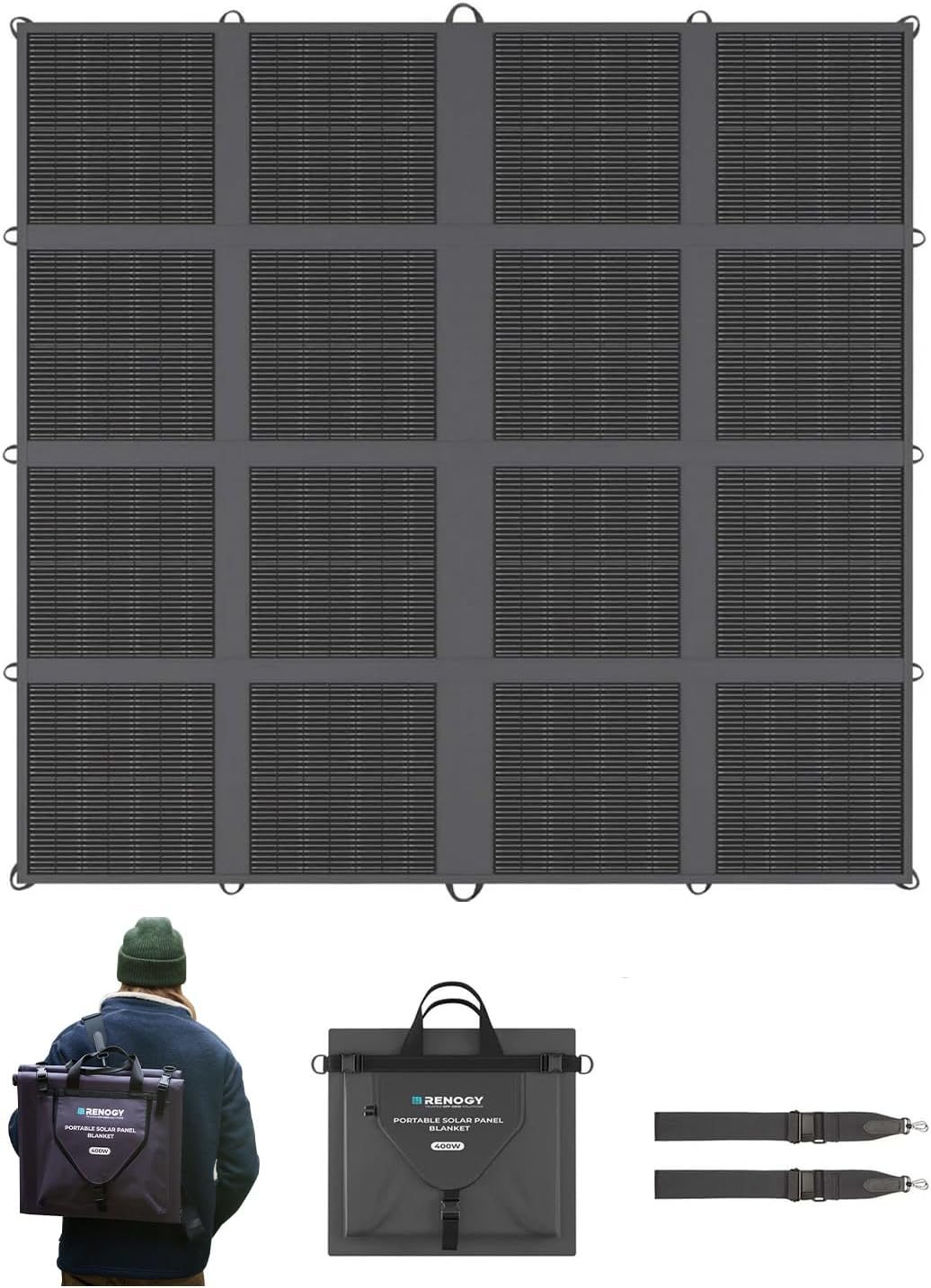
With 400 watts of actual charging capacity you fill a 1,440 watt hour pack in about four hours of good sun, even after real-world losses for heat, angle, and controller. That turns your midday rest stop into a full battery, not a top-off. Ride the low light, drop the blanket during the high sun, and you're rolling out at dusk with a fresh pack every single day.
WHAT YOU CAN CARRY
People think bike means "you can bring a water bottle and a granola bar." Wrong.
Between a rear rack, front rack, frame bag, and a set of proper panniers, you're looking at real cargo capacity, and a lot of these bikes have 400 pound plus total load ratings. Add a small trailer and you're hauling like a pack mule.
Here's what I'd have on mine:
Spares and repair, in the saddlebags:
- Two spare inner tubes, minimum. Three if you have room.
- A spare folding tire. Yes, they make them. Yes, it packs down.
- Tire levers and a patch kit with extra glue and patches.
- A compact hand pump or a small 12V inflator you can run off a battery pack.
- Spare chain and a chain breaker with quick links.
- Spare brake pads and a spare derailleur hanger. That hanger is a five dollar part that turns your bike into scrap when it snaps and you don't have one.
- Spare spokes and a spoke wrench.
- Multi-tool, small adjustable wrench, zip ties, and a roll of good tape.
- Chain lube. Small bottle. Your drivetrain will not survive mud and sand without it.
- Spare charge cable and a spare controller if you can get one.
PRO TIP: Run tire liners and sealant from day one. The number one thing that stops a bicycle is a flat, and the number one thing that causes a flat in a collapsed environment is the broken glass and roofing nails and shrapnel that will be all over every road surface you touch. Solve that problem before it happens.
Defense. You can run a proper handlebar or frame mount, a scabbard, or a top tube holster for a long gun. There are purpose built bike scabbards and rack mounted rifle carriers on the market right now, plus plenty of guys who mount a standard ATV gun boot to a rear rack and call it done. An AR or a short shotgun rides fine in a rack mounted scabbard as long as you secure the muzzle and use a retention strap. Sidearm goes on your body, not on the bike, because you and the bike will be separated at some point and the gun that matters is the one that's on YOU.
The rest. Water and a filter, food, med kit, comms, optics, shelter, fire, a knife and an axe, a small tarp, and a good light. Which is to say, everything on your list right now that you were planning to put in a backpack, except now you're not carrying it on your spine.
That last part matters more than people think. The single biggest killer of foot mobility is load. A man carrying 60 pounds on his back is destroyed in a day and injured in three. Put that 60 pounds on the bike and it costs you almost nothing.
THE OTHER STUFF NOBODY MENTIONS
Maintenance is nothing. A bicycle drivetrain is the most repairable machine ever built. There are no fluids to change, no timing to set, no injectors to clean, no fuel to go stale. If the motor dies you have a bike. If the display dies you have a bike. If the controller dies you have a bike. Compare that to a modern vehicle where a failed sensor bricks the whole thing and the replacement part exists in a warehouse three states away that isn't open anymore.
Parts are everywhere. Every neighborhood in America has bicycles in it. Garages, sheds, back yards, apartment racks, big box stores. Tires, tubes, chains, cables, brake pads, seats, wheels. A donor bike sitting behind an abandoned house is a parts bin. Try scavenging a fuel injector for a specific truck.
It's concealable. You can walk a bike into a treeline, lay it down, throw a tarp over it, and it disappears. You can carry it up a set of stairs into a room. You can hide it in a culvert. Where do you hide a truck?
Fitness stays intact. Pedal assist means you're working, but working at a level you choose. You stay conditioned instead of atrophying in a seat, and you conserve the energy you need for everything else.
It's dramatically safer than being on foot. This is the point I want to hammer hardest. Every bad thing that happens to people in a collapse happens to people who are slow, tired, loaded down, and stuck out in the open with no way to break contact. On foot you cannot outrun anything. On a bike you can break contact from almost any threat that isn't in a vehicle, and if it IS in a vehicle you go somewhere the vehicle can't follow, which is roughly everywhere.
CHARGING WITHOUT PUTTING YOURSELF ON DISPLAY
The one real objection to solar on a bug-out bike is that panels need sky, and sky means you can be seen. That's legitimate, but it only bites you if you charge in the wrong place. Don't camp near roads. Don't stop where a trail or a thoroughfare can see you. That's where everyone else moving through is going to be, and sitting still for four hours in the open is asking for trouble.
Get up into the woods instead. Find a clearing that's out of view of any road, a gap in the canopy with enough sky to feed the panel but back far enough that nobody passing by ever lays eyes on it. This is where your maps and satellite imagery earn their keep. You scout those openings before you ever roll out, so you already know where you're headed instead of hunting for a spot in the open.
And this is exactly what the bike gives you that a truck never could. It'll take you a mile or two up into terrain no vehicle can follow, quietly, and put real distance and elevation between you and anything with wheels. That reach is your security. You get deep into cover, drop the blanket flat in the clearing, and charge where no one's looking while you rest under the trees.
NOW THE HONEST PART: THE LIMITATIONS
I'm not going to sell you a fantasy. An ebike is the best option available. It is not a magic carpet. Here's the real list, and you need to plan around every single item on it.
1. You are completely exposed. No cab. No doors. No glass. No roof. Rain, wind, cold, heat, sun, insects, all of it lands directly on you. You will get soaked and you will get cold, and hypothermia is a wet 50 degree day with wind, not a blizzard. Quality rain shell, layers, and a way to get dry are not optional. Your gear needs to be in dry bags inside the panniers, not just in the panniers.
2. You are exposed to people. A hostile person with a rifle at 200 yards sees a man on a bicycle with no cover whatsoever. There is no armor. There is no engine block between you and anything. In a warzone or a lawless corridor you are a soft target moving in the open, and small arms fire ends the conversation instantly. This is the single largest drawback and there is no equipment fix for it. The mitigation is entirely tactical: move at low light, avoid roads, avoid choke points, use terrain, don't skyline yourself, and never travel in a predictable pattern.
3. Crash risk is real. No airbags, no seatbelt, no crumple zone. A wreck at 25 mph on a loaded fat bike, on bad surface, with no medical system in existence, is potentially a fatal event from a broken leg. Helmet. Gloves. Eye pro. Ride below your ability, not at it.
4. Range is conditional. Cold weather cuts lithium range hard, sometimes 30 to 40 percent. Headwind kills it. Mud kills it. Climbing kills it. Heavy cargo kills it. That 100 mile plan is a fair weather number and you need to know your bad weather number too.
5. Batteries are consumables. Lithium packs degrade with cycles and with time whether you use them or not. Store them at partial charge, keep them cool, and understand that a pack you bought today will not be the same pack in six or seven years. They also do not like being frozen, dropped, punctured, or soaked, and a damaged pack is a fire hazard you're sleeping next to.
6. Charging is slow. Wall charging is hours. Solar charging is a lot more hours, and a 100W panel in Florida in July is not a 100W panel in Ohio in December under overcast. Solar is a resupply strategy, not an on demand one. Plan your movement around your charging window, not the other way around.
7. Payload has a ceiling. You can carry a lot for a bicycle. You cannot carry a family, a dog crate, six months of food, and a generator. If you have small children, elderly parents, or a large family, an ebike is part of your plan, it is not your entire plan.
8. It's a theft magnet. It is small, valuable, obviously useful, and it can be ridden away by anyone who touches it. Lock it, keep eyes on it, pull the battery and take the display when you walk away, and never sleep with it out of arm's reach.
9. Weight when unpowered. With three packs, cargo, and a fat tire frame, you are pedaling a very heavy bicycle if the power is gone. It works, and it beats walking by a mile, but it isn't a road bike and you'll feel every hill.
10. No water crossing. Said it above, saying it again. Rivers, lakes, marsh, flooding. You will need a plan for water and the bike is not it.
11. Complexity you can't fix. The mechanical side of a bicycle is fully field repairable. The electronic side is not. If a controller fails or a motor winding burns out, you are not fixing that in the woods. You revert to pedal power and that's the end of it.
12. Range anxiety is a real tactical burden. Fuel you can find. Fuel you can siphon. Electricity in a grid-down world you can only make yourself. That's a mental load that never fully goes away.
None of that changes my conclusion. Every one of those limitations exists on a motorcycle too, and most of them exist on foot, where they're worse. The ebike still wins. But go into it clear eyed.
THE BIKES WORTH LOOKING AT RIGHT NOW
I'm not going to pretend there's one perfect survival ebike. There isn't. There are five or six that are very good for this, and which one is right depends on your terrain and your budget. Prices below are current ballpark as of this writing and these brands discount constantly, so check the site before you decide anything.
One caution before the list: Rad Power Bikes, long one of the biggest names in the space, filed for bankruptcy at the end of 2025 following a battery recall earlier that year. Their bikes are still out there on the used market. Just understand that warranty support and proprietary battery availability are a serious open question, and on a survival platform the ability to buy a replacement pack in three years matters as much as the spec sheet.
1. Lectric XPeak 2.0 — the off-road value pick, roughly $1,400
Lectric's off-road model is the one I'd point most people at first. Fat tires, real off-road geometry, hydraulic brakes, and a company that sells more ebikes in America than almost anybody, which means parts and batteries will be available for a long time. Reviewers put it in the same conversation as bikes several hundred dollars more expensive, with a similar all-terrain feel minus the premium extras. For a bug-out build where you want to spend your money on batteries and gear rather than on badge value, this is the sweet spot. Lectric's cheaper XP4 folding model starts around $999 and folds into a truck bed or a closet, which makes it a great secondary bike or a stash bike. lectricebikes.com
2. Aventon Aventure 3 — the all-terrain standard, roughly $1,800 to $2,000
This is the bike a lot of the industry measures itself against. A 750W motor, suspension fork, Shimano drivetrain, 26 by 4 inch fat tires, and ride quality that stands out well above the sub-$2,000 class, with confident stability on rough terrain and a suspension seatpost that takes the edge off. It climbs hard, which matters if your plan involves getting up into elevation. One thing to weigh for a survival build: Aventon's newer bikes run a connected 4G smart system for security features and over the air updates. That's a genuine anti-theft benefit today and something you may want to think about if you're the kind of person who'd rather not have a bike phoning home. aventon.com
3. Segway Xafari — full suspension and big range, roughly $1,800
The Xafari is the one I'd look hardest at for rough country. It's built on a full suspension frame with slightly smaller tires than the Aventure but more range and power at a very similar price, and the suspension adds real comfort over rough ground. If your escape corridor is fire roads, ruts, and rock rather than pavement, full suspension is not a luxury, it's the difference between riding for six hours and quitting after two. Segway's higher end Xyber model also sells with an extra battery configuration that pushes claimed range past 110 miles in one shot, which lines up exactly with the three pack philosophy in this article. segway.com
4. Ride1Up VORSA — modular and heavy duty, roughly $1,595 to $1,695
Ride1Up's Vorsa is built around versatility. Reviewers call it a winner if your priorities are heavy-duty power, range, versatility, and speed, with a 440 pound capacity, though at just over 70 pounds it's not the lightest thing to lift onto a rack. That load rating is the headline for our purposes. If you're hauling serious gear, or hauling a second person out, the Vorsa handles it. Ride1Up also makes the Prodigy V2, a Brose mid-drive belt drive machine around $1,895 to $2,495 that has been named best overall electric bike by testers for its responsive mid-drive, low maintenance belt drive, and high-end features at a reasonable price. A belt drive means no chain to lube, stretch, or snap, which is a real durability argument, but it also means you can't scavenge a replacement off an abandoned bicycle. Trade-off. Decide which failure mode scares you more. ride1up.com
5. Heybike ALPHA / Hero — the budget all-terrain play, roughly $1,299 to $1,899
Heybike sits at the aggressive end of the price war and runs deep discounts constantly. The ALPHA all-terrain routinely lands around $1,299 with a gear bundle, and their Hero model is a 1,000W carbon fiber all-terrain bike that has been discounted from $2,599 down to around $1,899. They also build dual-battery models like the Saturn and the Hauler, which is worth noting because a factory dual-battery setup solves half of your extended range problem out of the box instead of you rigging it yourself. Component quality is a step below the top tier. For the money, hard to argue with. heybike.com
PUT IT TOGETHER
Buy the bike that fits your terrain. Buy two extra batteries the same week you buy the bike, not "someday." Get a folding 100W to 200W (or the 400Watt folding panel and a controller that speaks to your charger. Load the panniers with tubes, a folding tire, a chain, a pump, and tools. Mount a scabbard. Put liners and sealant in the tires before you ever ride it.
Then go ride it. That's the part everybody skips. Ride it loaded. Ride it in the rain. Ride it at night. Ride it up something steep until the battery dies and then pedal it home so you know exactly what that feels like before it matters. Learn to change a tube in the dark. Learn what your real range is with your weight and your gear on your ground, not what the sticker claims.
They laughed about kayaks too. Then everybody bought one.
The guy who's stuck on the interstate with a full tank and nowhere to point it is going to watch somebody roll past him on a bicycle, quiet, loaded, and gone into the treeline before anybody can decide what to do about it.
Be that guy.
Help people. No conditions. No excuses. No fear.


