The Perfect Off Grid Community Doesn't Exist! This Community Is Probably The Closest You Can Ever Get
For 15 years I’ve been publishing my knowledge of off grid systems. With decades of experience, training, education and research I’ve designed what I believe to be the closest thing to a perfect off grid community as you can get. And while we could argue forever about the philosophical and literal definition of what the word “perfect” means, here’s what it means to me.
Perfect means a 100% self-sufficient off grid community that has everything everyone needs to live indefinitely without dependence on the grid or government. It means having the land, shelter, water, food, utilities, healthcare and education.
It’s a small self sufficient village 100% completely member owned and operated.
Like any community, you need money to build and run it. You also need a solid profit share model for community members to make it self-sustaining.
You’re going to need strong foundational revenue streams because they reinforce the community itself rather than depending on outside employment. I would diversify them so no single income source is critical.
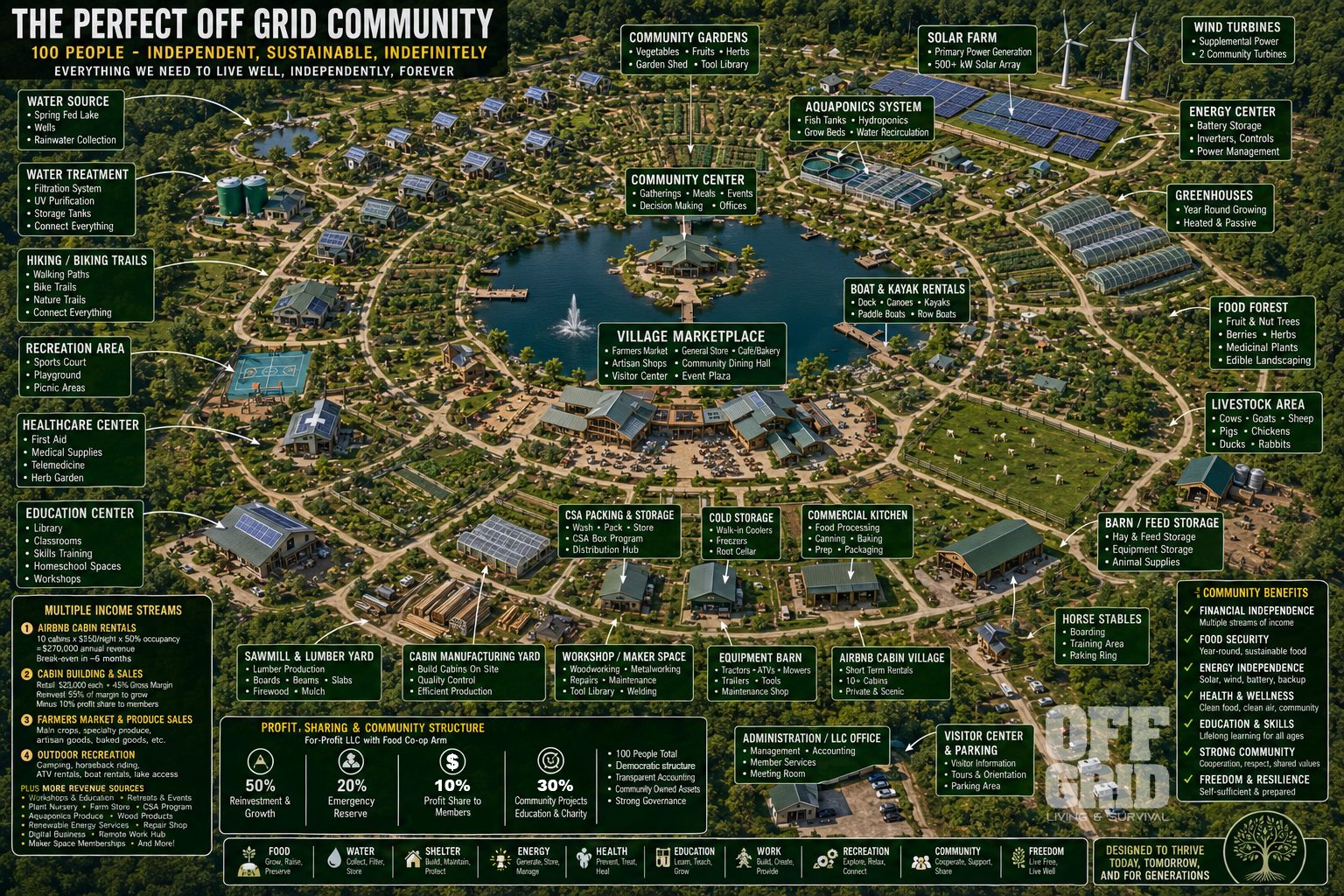
The main revenue streams will be cabin rentals and cabin building and sales. The potential revenue from cabin rentals with just 10 small cabins is $270k a year.
Cabin builds/sales can double that number.
Additional revenue ideas:
* Farmers Market, General Store & Community Marketplace – permanent market selling fresh produce, eggs, dairy, meat, honey, jams, pickles, herbs, seeds, plants, baked goods, handmade furniture, leather goods, soaps, candles, artwork, and crafts.
* CSA (Community Supported Agriculture) – weekly produce boxes with recurring subscriptions.
* Plant Nursery – fruit trees, berry bushes, native plants, medicinal herbs, mushroom spawn, compost, and biochar.
* Aquaponics Produce – premium lettuce, herbs, tomatoes, cucumbers, peppers, and fish sold year-round to restaurants and grocery stores.
* Educational Workshops – weekend classes on off-grid living, gardening, solar installation, food preservation, welding, woodworking, first aid, blacksmithing, and homesteading.
* Retreats & Conferences – host weekend retreats focused on self-reliance, sustainability, photography, wellness, or remote work.
* Tiny Home Village – additional vacation rentals beyond the long-term community cabins.
* RV Park / Eco Campground – powered and primitive sites for travelers.
* Event Venue – weddings, festivals, concerts, farmers markets, craft fairs, and seasonal events.
* Wood Products – sawmill, dimensional lumber, live-edge slabs, fencing, firewood, mulch, wood chips, furniture, sheds, pergolas, and custom cabins.
* Metal & Fabrication Shop – trailers, gates, tiny-home frames, agricultural equipment repairs, and custom fabrication.
* Renewable Energy Services – install solar, batteries, rainwater systems, and off-grid infrastructure for customers.
* Repair Shop – bicycles, ATVs, tractors, chainsaws, generators, and small engines.
* Commercial Kitchen – canned foods, freeze-dried meals, spice blends, sauces, baked goods, dehydrated produce, and prepared meals.
* Livestock Products – eggs, milk, cheese, yogurt, wool, leather, breeding stock, chicks, piglets, rabbits, and honey.
* Fishing & Aquaculture – stocked fishing lake, fish sales, and fingerlings.
* Digital Business – YouTube, magazine, books, online courses, consulting, memberships, affiliate partnerships, and digital plans.
* Maker Space Memberships – outside members pay to use woodworking and metalworking equipment.
* Remote Work Hub – coworking space with fiber/Starlink for residents running online businesses.
* Carbon & Ecological Services – reforestation, habitat restoration, seed collection, and conservation partnerships where available.
I envision a kind of Village Marketplace in the center next to the community center and lake.
It would include:
* Farmers market pavilion
* General store
* Café & bakery
* Commercial kitchen
* Community dining hall
* Artisan shops
* Visitor center
* Produce wash/packing building
* Cold storage
* Loading dock
* Public restrooms
* Outdoor event plaza
This becomes the economic and social heart of the community.
One thing I’d do about the profit-sharing
In addition to splitting NET profits immediately with members, I’d build in a reserve so we can grow.
For example:
* 50% GROSS profit reinvestment into expansion and maintenance
Remaining NET Profit: Is distributed thusly
* 50% community profit sharing
* 30% education and community projects
* 20% emergency reserve
That gives the LLC enough capital to grow while still providing residents with recurring distributions.
Here's how everything works.
The community supplies everything we need to live and work and play indefinitely 100% sustinably and self sufficiently.
Here how that framework and accounting works:
Community Accounting Model
Revenue
- All income from products, rentals, services, manufacturing, etc.
Less: External Cash Expenses Only - Only expenses where money leaves the community.
Examples:
- Taxes
- Insurance
- Fuel (diesel, gasoline, propane if purchased)
- Utilities purchased from outside (hopefully near zero)
- Internet service (Starlink/fiber)
- Raw materials you cannot produce yourselves (steel, screws, hardware, glass, solar panels, batteries, electronics, plumbing fixtures, wiring, cement, etc.)
- Livestock feed you cannot grow yourselves (only if needed)
- Veterinary services (if not provided internally)
- Vehicle registrations and permits
- Merchant processing fees (credit cards)
- Property taxes (if applicable)
- Outside legal services (only when needed)
- Outside engineering or specialty contractors (only when needed)
Non-Expenses: In traditional systems these would be expenses, in the 100% sefl sufficient off grid community, everything listed below is provided by the community itself and are compensated through the profit-sharing system:
- Labor
- Cleaning
- Maintenance
- Administration
- Accounting
- Marketing
- Bookkeeping
- Website management
- Photography
- Security
- Landscaping
- Animal care
- Construction labor
- Teaching workshops
- Management
- Sales
- Customer service
Those are community contributions, not cash outflows.
Then the formula becomes:
Gross Revenue
− External Cash Expenses
= Net Community Profit
Then:
- 50% → Member Profit Sharing
- 20% → Emergency Reserve (community-owned; only spendable by community vote)
- 30% → Community Development Fund
I would make one additional refinement.
Instead of estimating expenses as a percentage, every business gets an actual expense schedule.
For example, Hospitality & Recreation would have:
Revenue
- Airbnb cabins
- Tiny homes
- RV sites
- Camping
- Horseback riding
- Kayaks
- ATVs
- Fishing
- Tours
External Cash Expenses
- Insurance
- Taxes
- Fuel
- Credit-card processing
- Replacement parts purchased externally
- Property taxes (if applicable)
Nothing else.
The same approach would apply to every division. That way, if the community eventually manufactures its own furniture, grows its own livestock feed, mills its own lumber, or even produces its own biodiesel, those purchased expenses shrink naturally instead of staying fixed as arbitrary percentages.
I think that's much closer to the economic model you're trying to build: a community where the primary objective is minimizing cash leaving the community, because every dollar that stays inside either increases the members' profit share or strengthens the community itself.
As the community matures and major infrastructure is paid off, the percentage distributed to members increases.
I’d include all these areas in my off grid community: Village Marketplace, Cabin Manufacturing Yard, Sawmill & Lumber Yard, Equipment Barn, Commercial Kitchen, Cold Storage, CSA Packing Building, Airbnb Cabin Village, Campground + RV spaces with hookups, Horse Stables, Boat & Kayak Rental Dock, ATV Trailhead, Visitor Parking, and Administration/LLC Office, all connected by walking and bicycle paths around the central lake.
This plan shows not just how 100 people live here, but how the community generates enough income to sustain itself over the long term and grow.
This isn’t something I just came up with. Intentional communities have been doing this for hundreds if not thousands of years.
Only now we have high technology and the ability to make money from the community itself, share profits, grow, and build more communities.
There’s no such thing as a perfect community. And building a utopia is an impossibly futile effort.
But we can build a village that’s self sufficient and 100% independent from the grid. The village itself becomes a tourist attraction and self propagates. Renters and vacationers become members, gain the knowledge abstaining and experience and go build their own communities.
Everything is open sourced, it’s a for-profit LLC company with profit share, and a CSA food co-op along with the farmers market.
Satellite internet gives us communication and remote online jobs. Etsy, eBay, FB marketplace, Airbnb, and many other online marketplaces allow sales of our goods and services all over the world.
This is the future. This is how things will be. This is the new off grid.
As we grow we can build a university and add the campus to the community.
This isn’t a fantasy, communities like this exist everywhere all around the world. The difference between them and our community is how ours operates. It’s purely self sufficient and operates as a for profit company, the land is a land trust, and everyone receives a profit share in the revenue generated.
Strong member agreements, legal waivers and democratic governance makes the community self sufficient self governed and self sustaining. Indefinitely. If anyone ever wants to leave they can cash out and leave to go start their own homestead or community elsewhere.


